 Skip to content


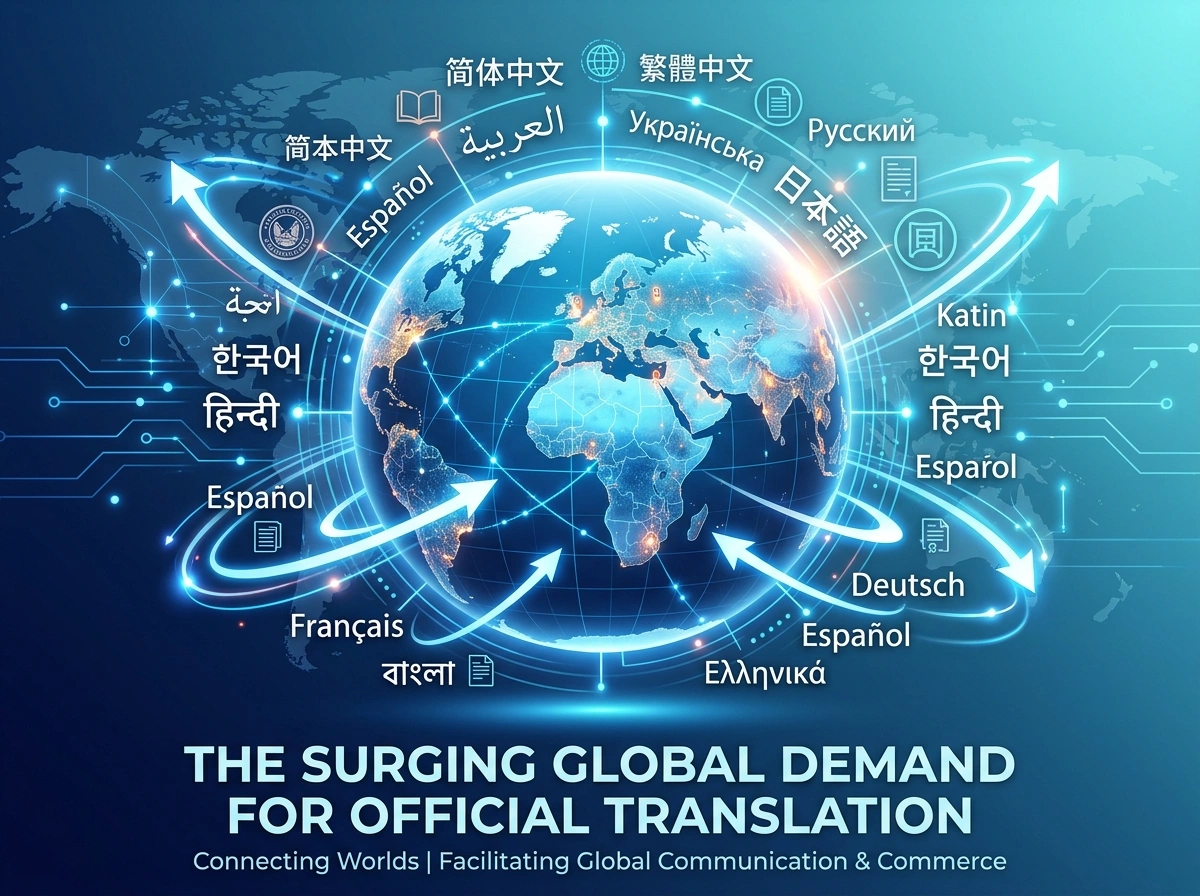
People and goods cross international borders at unprecedented volumes. Economies are tightly interwoven. As professionals, students, and families move freely across continents, they carry essential documents with them. Birth certificates, legal contracts, university transcripts, and medical records all need to travel across different jurisdictions.
Language barriers remain a stubborn hurdle in this interconnected environment. Moving from one country to another requires more than just booking a flight or signing a lease. It requires navigating complex bureaucratic systems that operate in completely different languages. Institutions demand absolute certainty regarding the documents they process. A simple misunderstanding on a visa application or a business contract can lead to severe legal and financial consequences.
Because of this constant movement and the strict requirements of government bodies, translation services have evolved from a helpful convenience to a strict legal necessity. You cannot simply ask a bilingual friend to translate a court document. Institutions require guaranteed accuracy, accountability, and standardized formatting. This reality is driving massive growth in the language services industry, forcing providers to scale operations and meet the specialized needs of a global population.
Understanding Official Translation: Definitions and Legal Requirements
Contents
- 1 Understanding Official Translation: Definitions and Legal Requirements
- 2 The Drivers of Demand
- 3 Key Sectors Requiring Official Translation
- 4 Challenges in Official Translation
- 5 The Future of Official Translation in an Interconnected World
- 6 Frequently Asked Questions
- 7 Navigating Cross-Border Communication Safely
An official translation is significantly different from a casual translation used for marketing or internal communication. It involves a specific legal protocol that verifies the accuracy and completeness of the translated text. When you submit a foreign language document to a government agency, court, or university, that institution needs proof that the English version exactly matches the original.
This verification typically takes the form of a signed Certificate of Accuracy. The translator or the translation agency includes a formal statement attesting to their competency in both languages and confirming that the translation is a true representation of the source material. For example, if you submit an official translation to the United States Citizenship and Immigration Services (USCIS), it must adhere strictly to the guidelines set forth in federal regulations, such as 8 CFR 103.2.
Different jurisdictions require varying levels of authentication. Some institutions only require a certified translation. Others mandate that the translation be notarized, meaning a Notary Public must witness the translator signing the Certificate of Accuracy. For documents that will be used internationally, an Apostille might be necessary under the Hague Convention. Understanding these distinct legal requirements is critical, as submitting the wrong type of translation will almost certainly result in application delays or outright rejections.
The Drivers of Demand
Several distinct macroeconomic and social factors are fueling the continuous need for certified language services.
Global Migration and Relocation
Millions of people relocate every year for work, study, or family reunification. Every single person who immigrates to a country with a different official language must undergo a rigorous documentation process. Visa applications, green card petitions, and naturalization processes require extensive paperwork. Applicants must provide birth certificates, marriage licenses, police records, and financial statements. Government agencies refuse to process these applications without accompanied certified translations. As immigration policies become more complex and heavily scrutinized, the reliance on professional language providers grows alongside it.
International Business Expansion
Companies operate on a global scale. A technology startup based in California might hire contractors in Ukraine, manufacture parts in China, and sell software to clients in Germany. This cross-border activity generates a mountain of paperwork. Employee handbooks, non-disclosure agreements, patent applications, and financial reports must be translated to comply with local laws and regulations. Corporate legal teams rely heavily on certified translators to ensure that business contracts remain legally binding across different judicial systems.
Stringent Legal Compliance
Regulatory environments are becoming tighter across the globe. Financial institutions, healthcare providers, and manufacturing companies must comply with international standards. When a dispute arises, or an audit takes place, auditors and judges require exact translations of all pertinent documents. The risk of mistranslation is simply too high. A single misplaced comma or misinterpreted legal term in a contract can alter the entire meaning of an agreement, leading to expensive litigation.
Key Sectors Requiring Official Translation
The demand for language services is not spread evenly across the economy. Certain heavily regulated sectors generate the bulk of the requirements for certified documentation.
The Legal Sector
The legal industry is entirely dependent on precise language. Law firms dealing with international clients frequently handle foreign evidence, witness depositions, and foreign court judgments. When presenting evidence in a United States federal or state court, all foreign language materials must be accompanied by an official translation. Judges and opposing counsel will scrutinize the documents for accuracy. Translators working in this sector must possess a deep understanding of legal terminology in both the source and target languages to ensure the translated document holds up under cross-examination.
The Medical and Healthcare Sector
Patient mobility and international clinical trials require the accurate translation of medical records. If a patient from Brazil seeks specialized treatment in the United States, American doctors need a precise translation of the patient’s medical history, vaccination records, and previous test results. Furthermore, pharmaceutical companies conducting drug trials in multiple countries must translate informed consent forms and trial protocols. Medical translation requires specialized subject matter expertise. A mistranslated dosage or a misunderstood allergy can result in fatal medical errors.
Academic Institutions
Universities and colleges worldwide receive millions of applications from international students each year. Admissions departments and credential evaluation boards need to verify a student’s previous academic performance. Applicants must submit certified translations of their high school diplomas, university transcripts, and letters of recommendation. These translations allow admissions officers to accurately convert foreign grading scales to the local equivalent, ensuring fair and standardized evaluation for all applicants.
Government and Administrative Agencies
At the state and federal levels, government agencies process foreign documents daily. The Department of Motor Vehicles (DMV) requires translated driver’s licenses and car titles for new residents looking to convert their driving privileges. The Social Security Administration (SSA) processes foreign birth and marriage certificates for benefits claims. Foreign embassies and consulates require translated paperwork for citizenship by descent applications. Government clerks are trained to reject any document that lacks the proper certification seals and signatures.
Challenges in Official Translation
Providing translation services that meet strict legal standards is a highly complex undertaking. Language providers must navigate several critical challenges to deliver documents that institutions will accept.
Maintaining Absolute Accuracy
The primary challenge is balancing literal accuracy with contextual meaning. Official documents often feature dense, archaic language. Translating a birth certificate from a rural municipality or a complex divorce decree requires meticulous attention to detail. Translators cannot omit information, add explanations, or guess at illegible handwriting. They must reflect the source document exactly as it appears, including stamps, seals, and signatures.
Ensuring Confidentiality and Security
Translation agencies handle highly sensitive personal and corporate data. Birth dates, social security numbers, medical histories, and proprietary corporate secrets flow through their servers every day. Providers must implement rigorous data security measures to protect client information. This includes encrypted file transfers, strict non-disclosure agreements for all staff, and secure data storage protocols. In the medical sector, translations must also comply strictly with the Health Insurance Portability and Accountability Act (HIPAA).
Meeting Specific Jurisdictional Standards
Requirements vary drastically between different institutions. What the DMV accepts in California might be rejected by a family court in New York. A credential evaluator might have entirely different formatting rules compared to the USCIS. Translation providers must stay current on the specific, ever-changing requirements of thousands of different government bodies, universities, and courts to ensure their certifications remain valid.
The Future of Official Translation in an Interconnected World
The language services industry is currently experiencing a technological revolution. Machine learning and artificial intelligence are changing how translations are processed, but they are not replacing the need for official certification.
While AI can quickly translate a menu or a casual email, it cannot legally certify a document. Algorithms struggle with the nuanced legal phrasing, poor handwriting, and faded ink often found on official records. Furthermore, government agencies require a human being to sign a legally binding declaration of accuracy.
The future will likely see a hybrid approach. Translators will use advanced software to assist with formatting and initial drafting, allowing them to work faster. However, expert human linguists will remain essential for reviewing, correcting, and ultimately certifying the final document. As long as nations maintain separate legal systems and official languages, the need for human accountability in document translation will persist.
Frequently Asked Questions
What makes a translation legally official?
A translation becomes official when it is accompanied by a signed Certificate of Accuracy. The translator or translation company must formally declare that they are fluent in both languages and that the translated text accurately represents the original document.
Do I need to provide the original document to the translator?
In most cases, you do not need to surrender your original physical documents. Translation agencies generally accept high-quality digital scans or clear photographs. The translator works from the digital copy and delivers the certified translation electronically or via physical mail.
Will USCIS accept translations done by family members?
No. USCIS rules stipulate that the translator must be competent to translate and must provide a formal certification. Having a friend or family member translate your immigration documents is a major conflict of interest and will usually result in a Request for Evidence (RFE) or application denial.
What is the difference between a certified and a notarized translation?
A certified translation includes the translator’s statement of accuracy. A notarized translation takes that exact same document and has a Notary Public verify the identity of the person signing the certificate. Notarization does not authenticate the quality of the translation itself; it simply verifies the identity of the signer.
Language differences will always exist, but they do not have to stop you from achieving your international goals. As global integration deepens, the administrative barriers to studying, working, and living abroad will continue to rely heavily on standardized documentation.
Securing proper language services is a fundamental step in any international process. Attempting to cut corners on document translation often leads to costly delays, rejected applications, and legal complications. By understanding the specific requirements of the institution you are applying to, and relying on qualified professionals who understand those legal standards, you can ensure your paperwork moves smoothly through any bureaucratic system.





Leave a Reply